
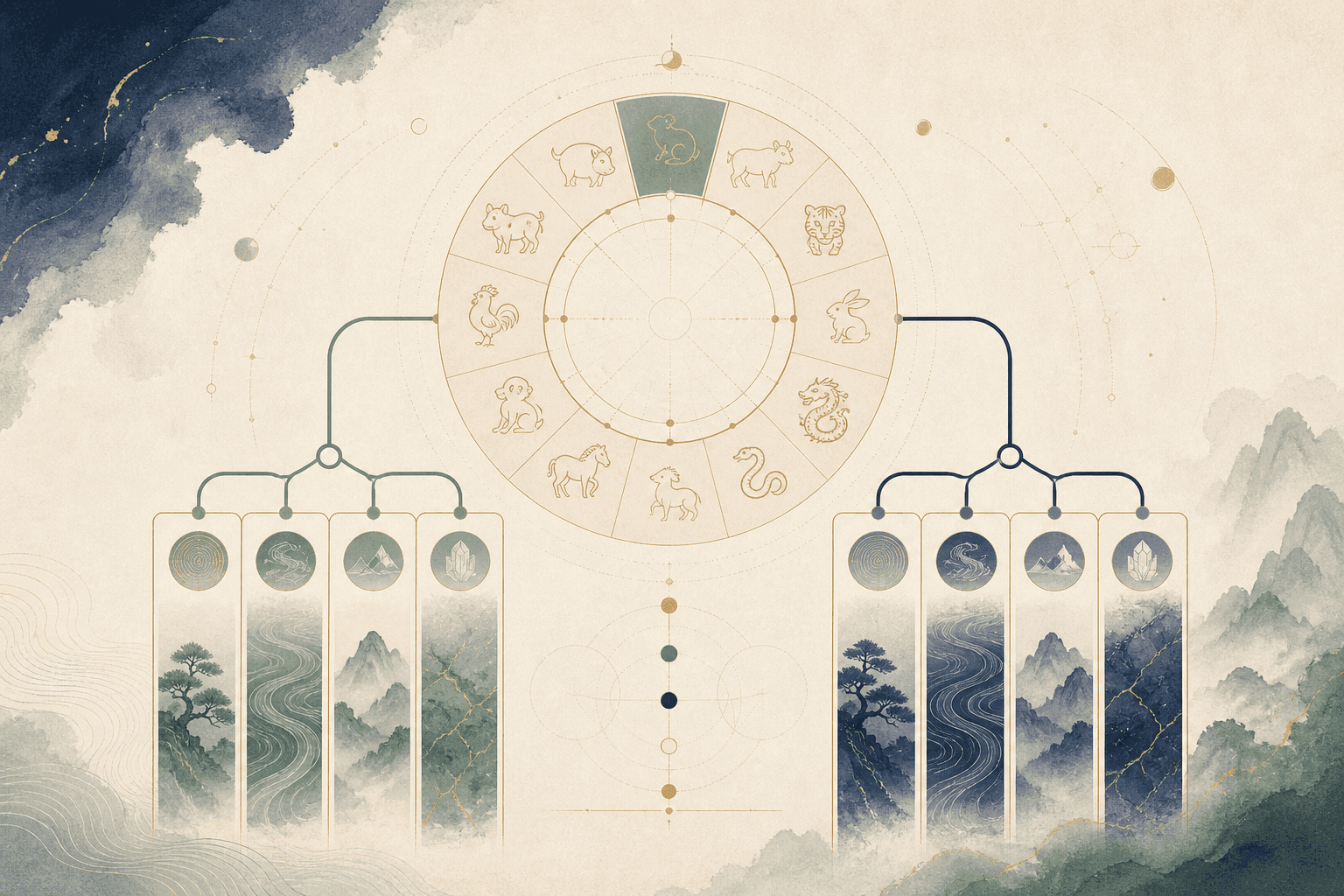
Your Chinese zodiac sign is the animal attached to your birth year's Earthly Branch. In Ba Zi, that is only one branch in a four-pillar chart: year, month, day, and hour.
That is why two people born under the same zodiac animal can receive different readings in Auspio. The animal still matters, but it is not the whole calculation.
Auspio's calculation method is documented on the permanent How Auspio Calculates Your Dates page. This article focuses on one practical question: why a twelve-animal sign is too broad to stand in for a Ba Zi chart.
Your zodiac animal is the year branch
In Auspio's Ba Zi model, a chart contains four pillars: year, month, day, and hour. Each pillar is a Heavenly Stem plus an Earthly Branch.
The zodiac animal comes from the year pillar's branch. That makes it a real part of the chart, but a limited one. It describes one branch position, not the full structure.
The day pillar also has special weight because Auspio's model defines the Day Master as the Heavenly Stem of the day pillar. Many personalized calculations then read other stems, branches, and elements relative to that Day Master.
So the useful comparison is not "zodiac versus Ba Zi" as if one cancels the other. The zodiac animal is inside Ba Zi. It is just one-twelfth of the branch cycle and one part of a larger chart.
The four pillars add missing context
A full Ba Zi chart has eight characters: four stems and four branches.
The year pillar gives one kind of context. The month pillar gives another. The day pillar supplies the Day Master and day branch. The hour pillar adds a further birth-time layer.
That extra context matters because Auspio does not only ask, "What is your animal?" It can ask questions such as:
- What is the user's Day Master element?
- Does today's stem generate, support, or clash with that Day Master?
- Does today's branch harmonize with or clash against the user's day branch?
- Which Ten God is formed by today's stem relative to the user's Day Master?
- Does a candidate date create personal affinity through chart-specific positions?
Those questions cannot be answered from the year animal alone.
Two people can share an animal and still diverge
Imagine two people who share the same zodiac animal because they were born in the same Ba Zi year. Their year branches match, but their day pillars do not have to match.
If one person has an Earth Day Master and another has a Metal Day Master, the same Fire day does not read the same way for both people in Auspio's element logic. Fire generates Earth, so it can feed the Earth Day Master. Fire overcomes Metal, so it can be treated as a clash for the Metal Day Master.
That example is simplified, but the mechanism is real in the source: Auspio compares the candidate day's stem element against the participant's Day Master element. The same day can therefore contribute differently for two people with the same zodiac animal.
The same idea appears in family compatibility. Auspio checks the day branch against a member's year animal, but it also checks Day Master element relationships and day-branch relationships. The zodiac layer is present; it is not the only layer.
How this changes auspicious-date selection
For a candidate date, Auspio's date-scoring engine combines multiple signals. It includes the Day Officer for the event type, zodiac compatibility between the day's branch and each participant's year animal, element harmony between the day's stem and each participant's Day Master, lunar-month cautions, and a personal affinity layer based on the participant's own chart.
That design is why a date can look generally suitable but still be less suitable for a specific person. A day may harmonize with one participant's year animal, clash with another participant's personal day branch, or interact differently with each participant's Day Master element.
This is also why Auspio can rank dates differently for different users searching the same window. The app is not only sorting a public calendar of good and bad days. It is evaluating candidate days against the chart data supplied by the people involved.
The Day Master changes the reading
The Day Master is the day pillar's Heavenly Stem. In Auspio, it is the anchor for several personalized calculations.
Daily Luck uses the Day Master element when it evaluates today's stem element, recommends colors, assigns direction strength, and interprets the day's Ten God. Yearly Outlook also reads the flowing year's stem as a Ten God relative to the Day Master, then adjusts favorability based on Day Master strength.
That is the main reason a twelve-animal description can feel broad. It groups many people under one year branch. Ba Zi narrows the reading by asking what the rest of the chart is doing, especially around the day pillar.
Zodiac still matters
None of this means the zodiac animal is useless. Auspio uses zodiac harmony and clash logic in date scoring and compatibility.
The point is proportion. A year animal can indicate branch relationships such as harmony or clash with a day branch. But it cannot provide the month pillar, Day Master, Ten God relationship, seasonal adjustment, or chart-specific affinity signals by itself.
For cultural shorthand, the zodiac animal is easy to remember. For personalized timing, Auspio needs the fuller chart.
Is my Chinese zodiac sign wrong?
Not necessarily. Your zodiac animal is a valid way to refer to the Earthly Branch of your Ba Zi year. The issue is scope: the animal is only one part of the chart, so it should not be treated as the full reading.
Can two people with the same zodiac need different dates?
Yes. If their day pillars, Day Masters, or other chart positions differ, the same candidate date can interact with them differently. Auspio's scoring checks both the year-animal layer and more personal chart layers.
Does Auspio ignore zodiac animals?
No. Auspio includes zodiac compatibility in date scoring and compatibility checks. It also reads Day Master element harmony, Day Officer fit, lunar-month cautions, Ten Gods, and personal affinity, so the zodiac animal is one signal among several.